Plato's Cave: Who Invented the Allegory
The allegory of the cave, a profound philosophical narrative, is widely attributed to the ancient Greek philosopher Plato. However, the intrigue lies not in who first coined the term, but in understanding the historical context and philosophical significance that led to its creation.
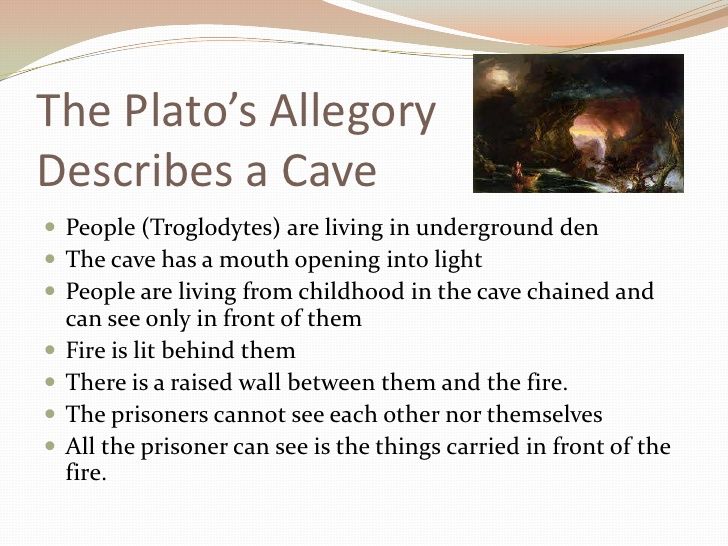
Before delving into the invention of this allegory, it's crucial to understand its core elements. The allegory, as presented in Plato's work "The Republic," describes a group of people who have lived their entire lives chained in a cave, facing a blank wall, and only seeing shadows cast by objects passing by a fire burning behind them. They believe these shadows are reality and give names to them accordingly.
The Historical Context and Plato's Life
Plato, born around 428 BCE in Athens, was a tumultuous period marked by the Peloponnesian War. This era of conflict and upheaval may have influenced Plato's views on society and governance, leading him to explore ideas about ideal states and justice.


Plato's teacher, Socrates, was executed in 399 BCE, an event that deeply affected Plato. Socrates' teachings, focused on questioning one's beliefs and seeking wisdom, significantly influenced Plato's thought processes and writings.
Plato's Educational and Travel Background
Plato himself was educated in various disciplines, including rhetoric, astronomy, geometry, and music, all of which contributed to his broad understanding of the world. He also traveled extensively, studying in other parts of Greece and even in Magna Graecia, the Greek colonies in southern Italy and Sicily.


These experiences exposed Plato to diverse cultures, ideas, and political systems, further enriching his perspective on societal structures and human nature. This intellectual journey likely laid the groundwork for creating the allegory of the cave.
The 'The Republic' and the Allegory's Initial Appearance
The allegory of the cave first appeared in Book VII of "The Republic," written by Plato sometime around 380 BCE. In this work, Socrates, the central character, systematically explores the concept of justice and the ideal city-state.
The allegory is introduced during a discussion of education at the end of Book VII. Here, Plato uses it as a metaphor to explain how people perceive reality, and how enlightenment can lead to understanding true forms or ideas.


Interpretations and Impact of the Allegory
Plato wasn't the first to use the sun as a symbol of ultimate reality or enlightenment. However, his unique cave metaphor has led to numerous interpretations, debates, and spawns of the original allegory in various forms of literature and art.
Some have focused on the idea that the 'cave' represents materialism or practical matters, while the 'sun' signifies transcendental or spiritual reality. Others have interpreted it as a metaphor for the human condition, or the struggle to ascend from ignorance to enlightened understanding.
The Allegory's Influence on Philosophy and Other Disciplines
The allegory of the cave has significantly influenced philosophy, particularly epistemology (the study of knowledge and belief), and metaphysics. It has also been incorporated into various fields, including art, literature, and education.


In art, the allegory has inspired countless paintings and sculptures, such as Rembrandt's "The Philosopher in Meditation" and surrealist René Magritte's "The Cave of the Philosophers." In literature, authors like C.S. Lewis and Aldous Huxley have referenced or expanded upon the allegory.
The Allegory's Relevance in Today's World
The allegory of the cave continues to resonate in contemporary society, even in the digital age. It can be seen as a metaphor for manipulative media or misinformation, with 'cave inhabitants' unknowingly influenced by shadows (processed information).
The allegory encourages critical thinking, self-reflection, and a pursuit of truth beyond surface appearances. It reminds us that true understanding can be uncomfortable and challenging to achieve but is ultimately liberating.
In the end, while it's Plato who first put forth the allegory of the cave, the philosophical depth and broad applicability of his metaphor ensure its ongoing relevance. Whether you're a philosopher, artist, or simply an individual seeking understanding, the allegory invites you to question, explore, and yearn for the truth 'beyond the cave.' So, join Socrates in his journey, leave the cave, and embrace the sun.
Related Articles

Plato's Cave Diagram: Analyzing the Allegory of the Shadows
Plato's Allegory of the Cave is a captivating philosophical thought experiment presented in his work "The Republic." This powerful metaphor explores the nature...
Simple Cave Allegory: Plato's Inexplicable Matrix
The Allegory of the Cave, often attributed to the ancient Greek philosopher Plato, is a powerful philosophical allegory that has captivated scholars, thinkers...
Allegory of the Cave: Plato's Iconic Vision Explained
Plato's "Allegory of the Cave" is a philosophical masterpiece that illuminates the journey of the soul towards enlightenment. This iconic metaphor, presented...
"Cave Explanation: The Dummies' Guide to Plato's Allegory"
The Allegory of the Cave, put forth by the Greek philosopher Plato in his work "The Republic", is a fascinating and thought-provoking story that has puzzled...
Plato's Cave Awakening: Exploring the Allegory in Action
Since its inception by ancient Greek philosopher Plato, the 'Allegory of the Cave' has served as a profound metaphor for our understanding of reality...

Understanding Plato's Cave: The Allegory Explained for Kids
The Allegory of the Cave is a fascinating story from the ancient world, written by the famous Greek philosopher Plato. Let's imagine we're in a classroom, and...