Streams and Rhymes
The melodic dance of raindrops on the roof, a symphony that has inspired poets and musicians alike, shares an intriguing characteristic with another art form - rhymes. Both can evoke emotion, convey meaning, and create harmony. But what exactly connects rain and rhymes aside from their sonorous qualities? Let's delve into this captivating connection, exploring the literary devices, cultural references, and scientific intrigue that unites these two seemingly disparate entities.
In the realm of poetics, rain and rhymes enjoy a rich relationship. Rain poetry, a subgenre of meteorological poetry, often employs rhyme schemes to capture the rhythmic patterns of raindrops. From the drizzling patter to the torrential downpour, poets have long used rhymes to mirror the dynamic nature of rainfall. But how does rhyme serve this purpose, and what other poetic techniques blend rain and rhymes?
Rhyme Schemes Mirroring Rainfall
One of the most straightforward ways poets combine rain and rhymes is through rhyme schemes. These recurring patterns of rhyming words at the ends of lines in stanzas mimic the consistent yet varying rhythm of rainfall. For instance, a typical iambic pentameter with an ABAB rhyme scheme can imitate the steady beat of raindrops, while a aa bb cc... scheme, known as a 'monorhyme' or ' glycol mediator,' can convey the persistency of rain.


A prime example of this technique is Samuel Taylor Coleridge's "The Nightingale," where the ABAB rhyme scheme echoes the rhythmic plopping of raindrops throughout the poem:
| "And from the ministry of soft and silent rain, |
| Then, why upon the threshold of his chamber door, |
| A sleeping form stretched out, and never stirr'd again, |
| A youth, who bore, soul-locked, one hope of earth and heaven!" |
Internal Rhymes and Assonance
In addition to end rhymes, internal rhymes and assonance can also create auditory connections between rain and rhymes. By utilizing rhyming words within a line or stressing similar vowel sounds, poets can weave rain-related imagery into their poems. For example, Emily Dickinson's "After great pain, a formal feeling comes" employs internal rhymes and assonance to evoke the damp, chilled atmosphere of rain:


| "The Feet, mechanical, go round – |
| Of ground - |
| And no defect of indolence,- |
| That is a curious Weight – a literaloplescence- An impersonal breath. |
The repetition of 'ground' and 'ound,' along with the assonant 'pain' and 'cold,' creates a sensory experience that mirrors the cold, dripping sensation of rain.
Alliteration and Consonance
Alliteration and consonance, two other phonetic devices, can also bring rain and rhymes together. By repeating initial consonant sounds or ending words with the same consonant, poets can create auditory rain patterns within their verses. Richard Wilbur's "June Rain Later" demonstrates this technique:
| "Upon the selfsame lawn where, on aevery summer noon, |
| The children, when their holidays were new, |
| Had played with delicate rain, |
| And skipped erect from every puddle's rim, |
| Now ages later, under the wet green leaves, |
| I walk alone." |
The consistent 'r' and 'n' sounds in this poem evoke the constant patter of raindrops, while the alliteration of 'summer' and 'selfsame' conveys the nostalgic, drizzly mood.


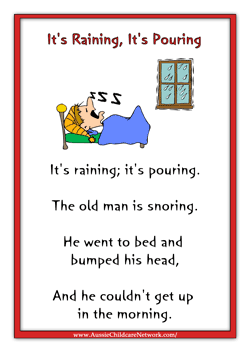
Beyond literary techniques, rain and rhymes intersect in various cultural contexts, from nursery rhymes to folk songs. But why does this connection persist, and what role might cognitive science play in explaining this enduring partnership?
Cognitive Science: Rain and Rhymes in the Brain
The enduring connection between rain and rhymes may stem from cognitive processes that link sounds with emotions and memories. Research has shown that humans possess a remarkable ability to associate specific sounds with particular meanings, an ability that presumably evolved to facilitate communication and enhance survival. This aptitude for sound-meaning pairing could underlie our affinity for rhymes and our enduring fascination with rain's sonic qualities.
Moreover, cognitive science may help explain why rain and rhymes often evoke nostalgia and melancholy. Studies have suggested that our brains store emotional memories in a 'hotspot' region called the amygdala, which may explain why the dull, droning sound of rain can evoke feelings of longing and nostalgia. Similarly, rhymes can tap into our emotive memory banks, recalling experiences and associations that stimulate our limbic systems and generate feelings of familiarity and comfort.


Rain, Rhymes, and the "Mozart Effect"
Anecdotal evidence and cognitive research have posited that exposure to certain sounds, such as rainfall or specific musical-rhythmic patterns, can induce a state of calm and contemplation. Popularized as the 'Mozart Effect,' this phenomenon has been linked to the beneficial effects of environmental stimuli on cognition and emotional regulation. While the scientific basis for this effect remains a topic of debate, it is undeniable that both rain and rhymes can, for some individuals, induce feelings of tranquility and introspection.
In the realm of literature, the symbiotic relationship between rain and rhymes continues to inspire and captivate. From classical poetry to contemporary song lyrics, this enduring connection enriches our cultural landscape and provides endless opportunities for creative exploration and expression.
So, the next time you find yourself entranced by the raindrops tapping against your window, take a moment to appreciate the myriad ways in which rain and rhymes intertwine. Allow the rhythm of raindrops to inform your rhymes, and let the beauty of the two merge into a symphony that nourishes both your mind and soul.
Related Articles

"Rhyme Mate: Find Words that Rhyme with Mine"
What rhymes with 'mine' is a question that often stumps poets and writers, given the unique ending sound of this pronoun. However, with a bit of linguistic...

Pray Along: Face Rhymes
Have you ever found yourself wondering if "prayer" and "face" rhyme? You might be surprised to learn that they don't in most English dialects. However...

Colorful Nursery Rhymes: Bring Your Child's Favorites to Life with These Cute Pics
The enchanting world of pictures nursery rhymes has captivated children and adults alike for centuries. These timeless tales, illustrated through vibrant...

Find My Rhyme
The phrase "rhymes with mine" is a common idiomatic expression that's often used in everyday conversation. So, what does it mean exactly, and where did this...

Counsel's Holiday Rhymes
When seeking solace and guidance, it's apt to yearn for words that resonate, especially those that rhyme with 'holiday', a time of relaxation and reflection...

What Rhymes with Cat: Purrfect Pairs
When looking for words that rhyme with "cat", one might initially think of common associations like "hat" or "flat". However, the world of rhyming words...